Exhibition route design
May 10, 2026
- The importance of exhibition route design
- Types of exhibition routes
- Key elements in exhibition route design
- Technology and exhibition route design
- Successful examples of exhibition route design
The importance of exhibition route design
Exhibition route design goes beyond the mere placement of objects in a space—it involves the strategic planning of how and in what order visitors interact with the information. A well-designed route can enhance both the emotional and intellectual impact of an exhibition, increasing visitor engagement and understanding.
To achieve this, it is essential to consider factors such as accessibility, flow of movement, lighting, content, and the graphic design of explanatory elements. Additionally, technology has broadened the possibilities for interaction through apps, touchscreens, and augmented reality.
Types of exhibition routes
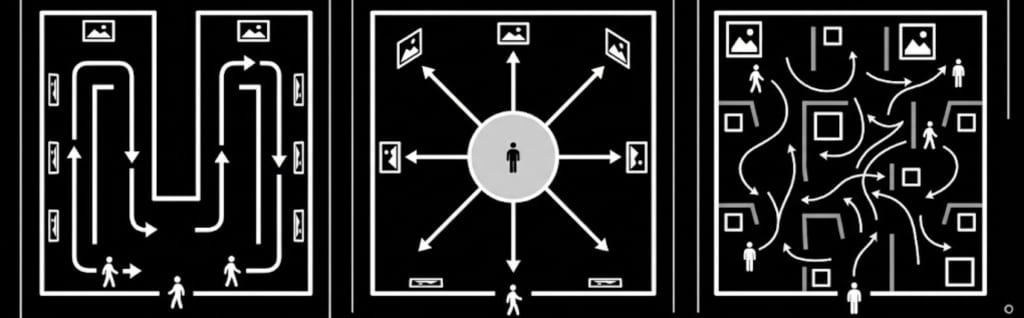
Depending on the exhibition's purpose and the available space, we may use different types of routes. Below are some common distribution types, though routes can be interpreted in many ways:
Linear Route
This format follows a predefined order, allowing for a chronological or sequential narrative. It is common in historical museums and thematic exhibitions, helping visitors understand the content in a logical progression.
Radial Route
In this layout, visitors start at a central point and can freely explore various sections. It is often found in interactive exhibitions and science centres, as well as in art displays that highlight a central work.
Free Route
Without a fixed path, visitors move at their own pace and choose which areas to explore. This layout is ideal for contemporary art exhibitions or galleries where works are displayed independently of one another.
Key elements in exhibition route design
We must integrate several essential elements to achieve an effective exhibition route:
a) Narrative and Storytelling
Every exhibition tells a story. Establishing a straightforward narrative helps guide the visitor and creates an emotional connection to the content.
b) Information Hierarchy
Visitors absorb better hierarchically organised information. Introductory panels, explanatory texts, and visual elements can help structure the content.
c) Visual and Sensory Elements
Combining images, sound, lighting, and textures contributes to a multisensory experience that enhances both information retention and visitor enjoyment.
d) Interactivity and Participation
Interactive exhibitions increase visitor engagement. Elements such as touchscreens, augmented reality games, or participatory activities enhance the experience's dynamic nature.
e) Accessibility and Comfort
It is essential to ensure that the route is accessible to everyone, including those with reduced mobility, visual impairments, or hearing difficulties. Space distribution should allow for a comfortable and natural flow of people.
Technology and exhibition route design
Technological innovations have transformed exhibition route design, enabling more personalised and immersive experiences. Some key tools include:
Virtual and Augmented Reality: Enable immersive journeys or enhance information through interactive digital content.
Audio Guides and Apps: Offer additional content in multiple languages and allow for personalised tours.
Intelligent Lighting Systems: Highlight key elements and create appropriate atmospheres depending on the type of exhibition.
Successful examples of exhibition route design
Louvre Museum (Paris)
With its structured layout, the Louvre allows visitors to navigate its vast collections efficiently without getting lost.
Guggenheim Museum (Bilbao)
Its architectural design directly influences the exhibition route, guiding visitors smoothly through its galleries.
The Museum of the Future (Dubai)
An example of technological integration, offering interactive experiences and futuristic spaces that immerse visitors in speculative narratives.
CONCLUSIONS
Exhibition route design is an essential tool for creating memorable experiences in museums and galleries. Careful planning that combines storytelling, technology, and interactivity can transform a simple exhibition into an immersive journey for visitors. With the ongoing evolution of digital tools and new storytelling strategies, the future of exhibitions promises to be more interactive, accessible, and impactful than ever.
Innovative Strategies in Exhibition Route Design
Exhibition route design has evolved with new strategies aimed at improving visitor interaction and experience. Some emerging trends include:
Personalised Routes: Some museums allow visitors to choose their own path using apps that suggest routes tailored to their personal interests.
Immersive Experiences: Installations that blend art, technology, and physical sensations—such as projection mapping rooms or augmented reality features.
Unconventional Use of Space: Exhibitions that utilise verticality, movement, and open layouts to transform the visitor's experience.
Gamification: The integration of playful elements like challenges, rewards, or missions that encourage active participation from the audience.
These innovative strategies not only enhance the impact of exhibition route design but also contribute to the accessibility and personalisation of exhibitions.

The difference between Museography and Museology
read
Didactic Museography: An Educational Approach to Exhibitions
read